Hilbert Space between the invisiball hears Harold Scott MacDonald Coxeter CC FRS FRSC
In a space where there are a proliferation of ideas explaining a proliferation of ideas the ideas get mixed up with the ideation whence the idea becomes the ideated causing
the in digest ion that is the ion of ion eye zat ion thus the idea is (obliterated)


Harold Scott MacDonald Coxeter
Harold Scott MacDonald Coxeter

Born 9 February 1907
London, England Died 31 March 2003 (aged 96)
Toronto, Ontario, Canada Alma mater University of Cambridge (B.A., 1929; Ph.D., 1931) Known for Coxeter element
Coxeter functor
Coxeter graph
Coxeter group
Coxeter matroid
Coxeter notation
Coxeter's loxodromic sequence of tangent circles
Coxeter–Dynkin diagram
Coxeter–Todd lattice
Boerdijk–Coxeter helix
Goldberg–Coxeter construction
Todd–Coxeter algorithm*
Tutte–Coxeter graph
LCF notation Spouse(s) Hendrina, died in 1999 Children a daughter, Susan Thomas, and a son, Edgar Awards - Smith's Prize (1931)
- Henry Marshall Tory Medal (1949)
- FPS (1950)
- Jeffery–Williams Prize (1973)
- CRM-Fields-PIMS prize (1995)
- Sylvester Medal (1997)
Scientific career Fields Geometry Institutions University of Toronto Doctoral advisor H. F. Baker[1] Doctoral students
Harold Scott MacDonald "Donald" Coxeter, CC, FRS, FRSC (9 February 1907 – 31 March 2003)[2] was a British and later also Canadian geometer. He is regarded as one of the greatest geometers of the 20th century.[3]
Harold Scott MacDonald Coxeter | |
|---|---|
 | |
| Born | 9 February 1907 London, England |
| Died | 31 March 2003 (aged 96) Toronto, Ontario, Canada |
| Alma mater | University of Cambridge (B.A., 1929; Ph.D., 1931) |
| Known for | Coxeter element Coxeter functor Coxeter graph Coxeter group Coxeter matroid Coxeter notation Coxeter's loxodromic sequence of tangent circles Coxeter–Dynkin diagram Coxeter–Todd lattice Boerdijk–Coxeter helix Goldberg–Coxeter construction Todd–Coxeter algorithm* Tutte–Coxeter graph LCF notation |
| Spouse(s) | Hendrina, died in 1999 |
| Children | a daughter, Susan Thomas, and a son, Edgar |
| Awards |
|
| Scientific career | |
| Fields | Geometry |
| Institutions | University of Toronto |
| Doctoral advisor | H. F. Baker[1] |
| Doctoral students | |
Harold Scott MacDonald "Donald" Coxeter, CC, FRS, FRSC (9 February 1907 – 31 March 2003)[2] was a British and later also Canadian geometer. He is regarded as one of the greatest geometers of the 20th century.[3]
Contents
Biography[edit]
Coxeter was born in Kensington to Harold Samuel Coxeter and Lucy (née Gee). His father had taken over the family business of Coxeter & Son, manufacturers of surgical instruments and compressed gases (including a mechanism for anaesthetising surgical patients with nitrous oxide), but was able to retire early and focus on sculpting and baritone singing; Lucy Coxeter was a portrait and landscape painter who had attended the Royal Academy of Arts. A maternal cousin was the architect Sir Giles Gilbert Scott.[4][2]
In his youth, Coxeter composed music and was an accomplished pianist at the age of 10.[5] He felt that mathematics and music were intimately related, outlining his ideas in a 1962 article on "Music and Mathematics" in the Canadian Music Journal.[5]
He was educated at King Alfred School, London and St George's School, Harpenden, where his best friend was John Flinders Petrie, later a mathematician for whom Petrie polygons were named. He was accepted at King's College, Cambridge in 1925, but decided to spend a year studying in hopes of gaining admittance to Trinity College, where the standard of mathematics was higher.[2] Coxeter won an entrance scholarship and went to Trinity College, Cambridge in 1926 to read mathematics. There he earned his BA (as Senior Wrangler) in 1928, and his doctorate in 1931.[5][6] In 1932 he went to Princeton University for a year as a Rockefeller Fellow, where he worked with Hermann Weyl, Oswald Veblen, and Solomon Lefschetz.[6] Returning to Trinity for a year, he attended Ludwig Wittgenstein's seminars on the philosophy of mathematics.[5] In 1934 he spent a further year at Princeton as a Procter Fellow.[6]
In 1936 Coxeter moved to the University of Toronto. In 1938 he and P. Du Val, H.T. Flather, and John Flinders Petrie published The Fifty-Nine Icosahedra with University of Toronto Press. In 1940 Coxeter edited the eleventh edition of Mathematical Recreations and Essays,[7] originally published by W. W. Rouse Ball in 1892. He was elevated to professor in 1948. Coxeter was elected a Fellow of the Royal Society of Canada in 1948 and a Fellow of the Royal Society in 1950. He met M. C. Escher in 1954 and the two became lifelong friends; his work on geometric figures helped inspire some of Escher's works, particularly the Circle Limit series based on hyperbolic tessellations. He also inspired some of the innovations of Buckminster Fuller.[6] Coxeter, M. S. Longuet-Higgins and J. C. P. Miller were the first to publish the full list of uniform polyhedra (1954).[8]
He worked for 60 years at the University of Toronto and published twelve books.
Coxeter was born in Kensington to Harold Samuel Coxeter and Lucy (née Gee). His father had taken over the family business of Coxeter & Son, manufacturers of surgical instruments and compressed gases (including a mechanism for anaesthetising surgical patients with nitrous oxide), but was able to retire early and focus on sculpting and baritone singing; Lucy Coxeter was a portrait and landscape painter who had attended the Royal Academy of Arts. A maternal cousin was the architect Sir Giles Gilbert Scott.[4][2]
In his youth, Coxeter composed music and was an accomplished pianist at the age of 10.[5] He felt that mathematics and music were intimately related, outlining his ideas in a 1962 article on "Music and Mathematics" in the Canadian Music Journal.[5]
He was educated at King Alfred School, London and St George's School, Harpenden, where his best friend was John Flinders Petrie, later a mathematician for whom Petrie polygons were named. He was accepted at King's College, Cambridge in 1925, but decided to spend a year studying in hopes of gaining admittance to Trinity College, where the standard of mathematics was higher.[2] Coxeter won an entrance scholarship and went to Trinity College, Cambridge in 1926 to read mathematics. There he earned his BA (as Senior Wrangler) in 1928, and his doctorate in 1931.[5][6] In 1932 he went to Princeton University for a year as a Rockefeller Fellow, where he worked with Hermann Weyl, Oswald Veblen, and Solomon Lefschetz.[6] Returning to Trinity for a year, he attended Ludwig Wittgenstein's seminars on the philosophy of mathematics.[5] In 1934 he spent a further year at Princeton as a Procter Fellow.[6]
In 1936 Coxeter moved to the University of Toronto. In 1938 he and P. Du Val, H.T. Flather, and John Flinders Petrie published The Fifty-Nine Icosahedra with University of Toronto Press. In 1940 Coxeter edited the eleventh edition of Mathematical Recreations and Essays,[7] originally published by W. W. Rouse Ball in 1892. He was elevated to professor in 1948. Coxeter was elected a Fellow of the Royal Society of Canada in 1948 and a Fellow of the Royal Society in 1950. He met M. C. Escher in 1954 and the two became lifelong friends; his work on geometric figures helped inspire some of Escher's works, particularly the Circle Limit series based on hyperbolic tessellations. He also inspired some of the innovations of Buckminster Fuller.[6] Coxeter, M. S. Longuet-Higgins and J. C. P. Miller were the first to publish the full list of uniform polyhedra (1954).[8]
He worked for 60 years at the University of Toronto and published twelve books.
Special relativity
Special relativity 
In physics, the special theory of relativity, or special relativity for short, is a scientific theory regarding the relationship between space and time. In Albert Einstein's original treatment, the theory is based on two postulates:[p 1][1][2]
- The laws of physics are invariant (that is, identical) in all inertial frames of reference (that is, frames of reference with no acceleration).
- The speed of light in vacuum is the same for all observers, regardless of the motion of the light source or the observer.

| Special relativity |
|---|
 |


In physics, the special theory of relativity, or special relativity for short, is a scientific theory regarding the relationship between space and time. In Albert Einstein's original treatment, the theory is based on two postulates:[p 1][1][2]
- The laws of physics are invariant (that is, identical) in all inertial frames of reference (that is, frames of reference with no acceleration).
- The speed of light in vacuum is the same for all observers, regardless of the motion of the light source or the observer.
Contents
Traditional "two postulates" approach to special relativity[edit]
Albert Einstein: Autobiographical Notes[p 5]
Einstein discerned two fundamental propositions that seemed to be the most assured, regardless of the exact validity of the (then) known laws of either mechanics or electrodynamics. These propositions were the constancy of the speed of light in a vacuum and the independence of physical laws (especially the constancy of the speed of light) from the choice of inertial system. In his initial presentation of special relativity in 1905 he expressed these postulates as:[p 1]
- The principle of relativity – the laws by which the states of physical systems undergo change are not affected, whether these changes of state be referred to the one or the other of two systems in uniform translatory motion relative to each other.[p 1]
- The principle of invariant light speed – "... light is always propagated in empty space with a definite velocity [speed] c which is independent of the state of motion of the emitting body" (from the preface).[p 1] That is, light in vacuum propagates with the speed c (a fixed constant, independent of direction) in at least one system of inertial coordinates (the "stationary system"), regardless of the state of motion of the light source.
The constancy of the speed of light was motivated by Maxwell's theory of electromagnetism[citation needed] and the lack of evidence for the luminiferous ether. There is conflicting evidence on the extent to which Einstein was influenced by the null result of the Michelson–Morley experiment.[13][14] In any case, the null result of the Michelson–Morley experiment helped the notion of the constancy of the speed of light gain widespread and rapid acceptance.
The derivation of special relativity depends not only on these two explicit postulates, but also on several tacit assumptions (made in almost all theories of physics), including the isotropy and homogeneity of space and the independence of measuring rods and clocks from their past history.[p 6]
Following Einstein's original presentation of special relativity in 1905, many different sets of postulates have been proposed in various alternative derivations.[15] However, the most common set of postulates remains those employed by Einstein in his original paper. A more mathematical statement of the principle of relativity made later by Einstein, which introduces the concept of simplicity not mentioned above is:
Henri Poincaré provided the mathematical framework for relativity theory by proving that Lorentz transformations are a subset of his Poincaré group of symmetry transformations. Einstein later derived these transformations from his axioms.
Many of Einstein's papers present derivations of the Lorentz transformation based upon these two principles.[p 7]
Albert Einstein: Autobiographical Notes[p 5]
Einstein discerned two fundamental propositions that seemed to be the most assured, regardless of the exact validity of the (then) known laws of either mechanics or electrodynamics. These propositions were the constancy of the speed of light in a vacuum and the independence of physical laws (especially the constancy of the speed of light) from the choice of inertial system. In his initial presentation of special relativity in 1905 he expressed these postulates as:[p 1]
- The principle of relativity – the laws by which the states of physical systems undergo change are not affected, whether these changes of state be referred to the one or the other of two systems in uniform translatory motion relative to each other.[p 1]
- The principle of invariant light speed – "... light is always propagated in empty space with a definite velocity [speed] c which is independent of the state of motion of the emitting body" (from the preface).[p 1] That is, light in vacuum propagates with the speed c (a fixed constant, independent of direction) in at least one system of inertial coordinates (the "stationary system"), regardless of the state of motion of the light source.
The constancy of the speed of light was motivated by Maxwell's theory of electromagnetism[citation needed] and the lack of evidence for the luminiferous ether. There is conflicting evidence on the extent to which Einstein was influenced by the null result of the Michelson–Morley experiment.[13][14] In any case, the null result of the Michelson–Morley experiment helped the notion of the constancy of the speed of light gain widespread and rapid acceptance.
The derivation of special relativity depends not only on these two explicit postulates, but also on several tacit assumptions (made in almost all theories of physics), including the isotropy and homogeneity of space and the independence of measuring rods and clocks from their past history.[p 6]
Following Einstein's original presentation of special relativity in 1905, many different sets of postulates have been proposed in various alternative derivations.[15] However, the most common set of postulates remains those employed by Einstein in his original paper. A more mathematical statement of the principle of relativity made later by Einstein, which introduces the concept of simplicity not mentioned above is:
Henri Poincaré provided the mathematical framework for relativity theory by proving that Lorentz transformations are a subset of his Poincaré group of symmetry transformations. Einstein later derived these transformations from his axioms.
Many of Einstein's papers present derivations of the Lorentz transformation based upon these two principles.[p 7]
Reduced Planck constant[edit]
Implicit in the dimensions of the Planck constant is the fact that the SI unit of frequency, the hertz, represents one complete cycle, 360 degrees or 2π radians, per second.
In applications where it is natural to use the angular frequency (i.e. where the frequency is expressed in terms of radians per second instead of cycles per second or hertz) it is often useful to absorb a factor of 2π into the Planck constant. The resulting constant is called the reduced Planck constant or Dirac constant. It is equal to the Planck constant divided by 2π, and is denoted by (pronounced "h-bar"):[note 2]


Value[edit]
The Planck constant has dimensions of angular momentum. In SI units, the Planck constant is expressed in joules per hertz (J⋅Hz−1) or joule-seconds (J⋅s).


The above values have been adopted as fixed in the 2019 redefinition of the SI base units.
Natural units[edit]
In the system of "natural units" used by theoretical physicists, is defined to be exactly one. In these units, h is then exactly .

Mathematical Proportionality


In mathematics, two sequences of numbers, often experimental data, are proportional or directly proportional if their corresponding elements have a constant ratio, which is called the coefficient of proportionality or proportionality constant. Two sequences are inversely proportional if corresponding elements have a constant product, also called the coefficient of proportionality.
This definition is commonly extended to related varying quantities, which are often called variables. This meaning of variable is not the common meaning of the term in mathematics (see variable (mathematics)); these two different concepts share the same name for historical reasons.
Two functions and are proportional if their ratio is a constant function.


If several pairs of variables share the same direct proportionality constant, the equation expressing the equality of these ratios is called a proportion, e.g., ab = xy = ⋯ = k (for details see Ratio). Proportionality is closely related to linearity.
Pythagorean identity[edit]
Two vectors u and v in a Hilbert space H are orthogonal when ⟨u, v⟩ = 0. The notation for this is u ⊥ v. More generally, when S is a subset in H, the notation u ⊥ S means that u is orthogonal to every element from S.
When u and v are orthogonal, one has

By induction on n, this is extended to any family u1, ..., un of n orthogonal vectors,

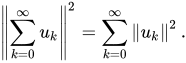
Whereas the Pythagorean identity as stated is valid in any inner product space, completeness is required for the extension of the Pythagorean identity to series. A series Σuk of orthogonal vectors converges in H if and only if the series of squares of norms converges, and
Parallelogram identity and polarization[edit]

By definition, every Hilbert space is also a Banach space. Furthermore, in every Hilbert space the following parallelogram identity holds:

Conversely, every Banach space in which the parallelogram identity holds is a Hilbert space, and the inner product is uniquely determined by the norm by the polarization identity.[50] For real Hilbert spaces, the polarization identity is

For complex Hilbert spaces, it is

The parallelogram law implies that any Hilbert space is a uniformly convex Banach space.[51]
Hilbert space

In mathematics, Hilbert spaces (named after David Hilbert) allow generalizing the methods of linear algebra and calculus from (finite-dimensional) Euclidean vector spaces to spaces that may be infinite-dimensional. A Hilbert space is a vector space equipped with an inner product which defines a distance function for which it is a complete metric space. Hilbert spaces arise naturally and frequently in mathematics and physics, typically as function spaces.
The earliest Hilbert spaces were studied from this point of view in the first decade of the 20th century by David Hilbert, Erhard Schmidt, and Frigyes Riesz. They are indispensable tools in the theories of partial differential equations, quantum mechanics, Fourier analysis (which includes applications to signal processing and heat transfer), and ergodic theory (which forms the mathematical underpinning of thermodynamics). John von Neumann coined the term Hilbert space for the abstract concept that underlies many of these diverse applications. The success of Hilbert space methods ushered in a very fruitful era for functional analysis. Apart from the classical Euclidean vector spaces, examples of Hilbert spaces include spaces of square-integrable functions, spaces of sequences, Sobolev spaces consisting of generalized functions, and Hardy spaces of holomorphic functions.
Geometric intuition plays an important role in many aspects of Hilbert space theory. Exact analogs of the Pythagorean theorem and parallelogram law hold in a Hilbert space. At a deeper level, perpendicular projection onto a linear subspace or a subspace (the analog of "dropping the altitude" of a triangle) plays a significant role in optimization problems and other aspects of the theory. An element of a Hilbert space can be uniquely specified by its coordinates with respect to an orthonormal basis, in analogy with Cartesian coordinates in classical geometry. When this basis is countably infinite, it allows identifying the Hilbert space with the space of the infinite sequences that are square-summable. The latter space is often in the older literature referred to as the Hilbert space.
Fourier analysis[edit]


One of the basic goals of Fourier analysis is to decompose a function into a (possibly infinite) linear combination of given basis functions: the associated Fourier series. The classical Fourier series associated to a function f defined on the interval [0, 1] is a series of the form
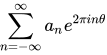
where
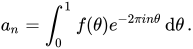
The example of adding up the first few terms in a Fourier series for a sawtooth function is shown in the figure. The basis functions are sine waves with wavelengths λn (for integer n) shorter than the wavelength λ of the sawtooth itself (except for n = 1, the fundamental wave). All basis functions have nodes at the nodes of the sawtooth, but all but the fundamental have additional nodes. The oscillation of the summed terms about the sawtooth is called the Gibbs phenomenon.
A significant problem in classical Fourier series asks in what sense the Fourier series converges, if at all, to the function f. Hilbert space methods provide one possible answer to this question.[36] The functions en(θ) = e2πinθ form an orthogonal basis of the Hilbert space L2([0, 1]). Consequently, any square-integrable function can be expressed as a series

and, moreover, this series converges in the Hilbert space sense (that is, in the L2 mean).
The problem can also be studied from the abstract point of view: every Hilbert space has an orthonormal basis, and every element of the Hilbert space can be written in a unique way as a sum of multiples of these basis elements. The coefficients appearing on these basis elements are sometimes known abstractly as the Fourier coefficients of the element of the space.[37] The abstraction is especially useful when it is more natural to use different basis functions for a space such as L2([0, 1]). In many circumstances, it is desirable not to decompose a function into trigonometric functions, but rather into orthogonal polynomials or wavelets for instance,[38] and in higher dimensions into spherical harmonics.[39]
For instance, if en are any orthonormal basis functions of L2[0, 1], then a given function in L2[0, 1] can be approximated as a finite linear combination[40]

The coefficients {aj} are selected to make the magnitude of the difference ||f − fn||2 as small as possible. Geometrically, the best approximation is the orthogonal projection of f onto the subspace consisting of all linear combinations of the {ej}, and can be calculated by[41]
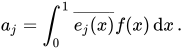
That this formula minimizes the difference ||f − fn||2 is a consequence of Bessel's inequality and Parseval's formula.
In various applications to physical problems, a function can be decomposed into physically meaningful eigenfunctions of a differential operator (typically the Laplace operator): this forms the foundation for the spectral study of functions, in reference to the spectrum of the differential operator.[42] A concrete physical application involves the problem of hearing the shape of a drum: given the fundamental modes of vibration that a drumhead is capable of producing, can one infer the shape of the drum itself?[43] The mathematical formulation of this question involves the Dirichlet eigenvalues of the Laplace equation in the plane, that represent the fundamental modes of vibration in direct analogy with the integers that represent the fundamental modes of vibration of the violin string.
Spectral theory also underlies certain aspects of the Fourier transform of a function. Whereas Fourier analysis decomposes a function defined on a compact set into the discrete spectrum of the Laplacian (which corresponds to the vibrations of a violin string or drum), the Fourier transform of a function is the decomposition of a function defined on all of Euclidean space into its components in the continuous spectrum of the Laplacian. The Fourier transformation is also geometrical, in a sense made precise by the Plancherel theorem, that asserts that it is an isometry of one Hilbert space (the "time domain") with another (the "frequency domain"). This isometry property of the Fourier transformation is a recurring theme in abstract harmonic analysis (since it reflects the conservation of energy for the continuous Fourier Transform), as evidenced for instance by the Plancherel theorem for spherical functions occurring in noncommutative harmonic analysis.
Quantum mechanics[edit]

In the mathematically rigorous formulation of quantum mechanics, developed by John von Neumann,[44] the possible states (more precisely, the pure states) of a quantum mechanical system are represented by unit vectors (called state vectors) residing in a complex separable Hilbert space, known as the state space, well defined up to a complex number of norm 1 (the phase factor). In other words, the possible states are points in the projectivization of a Hilbert space, usually called the complex projective space. The exact nature of this Hilbert space is dependent on the system; for example, the position and momentum states for a single non-relativistic spin zero particle is the space of all square-integrable functions, while the states for the spin of a single proton are unit elements of the two-dimensional complex Hilbert space of spinors. Each observable is represented by a self-adjoint linear operator acting on the state space. Each eigenstate of an observable corresponds to an eigenvector of the operator, and the associated eigenvalue corresponds to the value of the observable in that eigenstate.[45]
The inner product between two state vectors is a complex number known as a probability amplitude. During an ideal measurement of a quantum mechanical system, the probability that a system collapses from a given initial state to a particular eigenstate is given by the square of the absolute value of the probability amplitudes between the initial and final states.[46] The possible results of a measurement are the eigenvalues of the operator—which explains the choice of self-adjoint operators, for all the eigenvalues must be real. The probability distribution of an observable in a given state can be found by computing the spectral decomposition of the corresponding operator.[47]
For a general system, states are typically not pure, but instead are represented as statistical mixtures of pure states, or mixed states, given by density matrices: self-adjoint operators of trace one on a Hilbert space.[48] Moreover, for general quantum mechanical systems, the effects of a single measurement can influence other parts of a system in a manner that is described instead by a positive operator valued measure. Thus the structure both of the states and observables in the general theory is considerably more complicated than the idealization for pure states.[49]
Color perception[edit]
Any true physical color can be represented by a combination of pure spectral colors. As physical colors can be composed of any number of spectral colors, the space of physical colors may aptly be represented by a Hilbert space over spectral colors. Humans have three types of cone cells for color perception, so the perceivable colors can be represented by 3-dimensional Euclidean space. The many-to-one linear mapping from the Hilbert space of physical colors to the Euclidean space of human perceivable colors explains why many distinct physical colors may be perceived by humans to be identical (e.g., pure yellow light versus a mix of red and green light, see metamerism).


