guillotine known as the Fallbeil und Köpfsmaschine QED

Yang Mills Gauge Group


Gibbs free energy
Thermodynamics 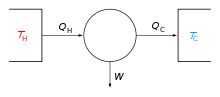
In thermodynamics, the Gibbs free energy (or Gibbs energy; symbol ) is a thermodynamic potential that can be used to calculate the maximum amount of work that may be performed by a thermodynamically closed system at constant temperature and pressure. It also provides a necessary condition for processes such as chemical reactions that may occur under these conditions.
The Gibbs free energy change (, measured in joules in SI) is the maximum amount of non-expansion work that can be extracted from a closed system (one that can exchange heat and work with its surroundings, but not matter) at fixed temperature and pressure. This maximum can be attained only in a completely reversible process. When a system transforms reversibly from an initial state to a final state under these conditions, the decrease in Gibbs free energy equals the work done by the system to its surroundings, minus the work of the pressure forces.[1]
The Gibbs energy is the thermodynamic potential that is minimized when a system reaches chemical equilibrium at constant pressure and temperature when not driven by an applied electrolytic voltage. Its derivative with respect to the reaction coordinate of the system then vanishes at the equilibrium point. As such, a reduction in is necessary for a reaction to be spontaneous under these conditions.
The concept of Gibbs free energy, originally called available energy, was developed in the 1870s by the American scientist Josiah Willard Gibbs. In 1873, Gibbs described this "available energy" as[2]: 400
The initial state of the body, according to Gibbs, is supposed to be such that "the body can be made to pass from it to states of dissipated energy by reversible processes". In his 1876 magnum opus On the Equilibrium of Heterogeneous Substances, a graphical analysis of multi-phase chemical systems, he engaged his thoughts on chemical-free energy in full.
If the reactants and products are all in their thermodynamic standard states, then the defining equation is written as , where is enthalpy, is absolute temperature, and is entropy.
| Thermodynamics |
|---|
|

In thermodynamics, the Gibbs free energy (or Gibbs energy; symbol ) is a thermodynamic potential that can be used to calculate the maximum amount of work that may be performed by a thermodynamically closed system at constant temperature and pressure. It also provides a necessary condition for processes such as chemical reactions that may occur under these conditions.

The Gibbs free energy change (, measured in joules in SI) is the maximum amount of non-expansion work that can be extracted from a closed system (one that can exchange heat and work with its surroundings, but not matter) at fixed temperature and pressure. This maximum can be attained only in a completely reversible process. When a system transforms reversibly from an initial state to a final state under these conditions, the decrease in Gibbs free energy equals the work done by the system to its surroundings, minus the work of the pressure forces.[1]

The Gibbs energy is the thermodynamic potential that is minimized when a system reaches chemical equilibrium at constant pressure and temperature when not driven by an applied electrolytic voltage. Its derivative with respect to the reaction coordinate of the system then vanishes at the equilibrium point. As such, a reduction in is necessary for a reaction to be spontaneous under these conditions.
The concept of Gibbs free energy, originally called available energy, was developed in the 1870s by the American scientist Josiah Willard Gibbs. In 1873, Gibbs described this "available energy" as[2]: 400
The initial state of the body, according to Gibbs, is supposed to be such that "the body can be made to pass from it to states of dissipated energy by reversible processes". In his 1876 magnum opus On the Equilibrium of Heterogeneous Substances, a graphical analysis of multi-phase chemical systems, he engaged his thoughts on chemical-free energy in full.
If the reactants and products are all in their thermodynamic standard states, then the defining equation is written as , where is enthalpy, is absolute temperature, and is entropy.



Exergonic process
(Redirected from Exergonic)
This article relies largely or entirely on a single source. (May 2009)
 Look up exergonic in Wiktionary, the free dictionary.
An exergonic process is one which there is a positive flow of energy from the system to the surroundings. This is in contrast with an endergonic process.[1] Constant pressure, constant temperature reactions are exergonic if and only if the Gibbs free energy change is negative (∆G < 0). "Exergonic" (from the prefix exo-, derived for the Greek word ἔξω exō, "outside" and the suffix -ergonic, derived from the Greek word ἔργον ergon, "work") means "releasing energy in the form of work". In thermodynamics, work is defined as the energy moving from the system (the internal region) to the surroundings (the external region) during a given process.
All physical and chemical systems in the universe follow the second law of thermodynamics and proceed in a downhill, i.e., exergonic, direction. Thus, left to itself, any physical or chemical system will proceed, according to the second law of thermodynamics, in a direction that tends to lower the free energy of the system, and thus to expend energy in the form of work. These reactions occur spontaneously.
A chemical reaction is also exergonic when spontaneous. Thus in this type of reactions the Gibbs free energy decreases. The entropy is included in any change of the Gibbs free energy. This differs from an exothermic reaction or an endothermic reaction where the entropy is not included. The Gibbs free energy is calculated with the Gibbs–Helmholtz equation:
where:
- T = temperature in kelvins (K)
- ΔG = change in the Gibbs free energy
- ΔS = change in entropy (at 298 K) as ΔS = Σ{S(Product)} − Σ{S(Reagent)}
- ΔH = change in enthalpy (at 298 K) as ΔH = Σ{H(Product)} − Σ{H(Reagent)}
A chemical reaction progresses spontaneously only when the Gibbs free energy decreases, in that case the ΔG is negative. In exergonic reactions the ΔG is negative and in endergonic reactions the ΔG is positive:
- exergon
- endergon
where:
- equals the change in the Gibbs free energy after completion of a chemical reaction.
 | This article relies largely or entirely on a single source. (May 2009) |
An exergonic process is one which there is a positive flow of energy from the system to the surroundings. This is in contrast with an endergonic process.[1] Constant pressure, constant temperature reactions are exergonic if and only if the Gibbs free energy change is negative (∆G < 0). "Exergonic" (from the prefix exo-, derived for the Greek word ἔξω exō, "outside" and the suffix -ergonic, derived from the Greek word ἔργον ergon, "work") means "releasing energy in the form of work". In thermodynamics, work is defined as the energy moving from the system (the internal region) to the surroundings (the external region) during a given process.
All physical and chemical systems in the universe follow the second law of thermodynamics and proceed in a downhill, i.e., exergonic, direction. Thus, left to itself, any physical or chemical system will proceed, according to the second law of thermodynamics, in a direction that tends to lower the free energy of the system, and thus to expend energy in the form of work. These reactions occur spontaneously.
A chemical reaction is also exergonic when spontaneous. Thus in this type of reactions the Gibbs free energy decreases. The entropy is included in any change of the Gibbs free energy. This differs from an exothermic reaction or an endothermic reaction where the entropy is not included. The Gibbs free energy is calculated with the Gibbs–Helmholtz equation:

where:
- T = temperature in kelvins (K)
- ΔG = change in the Gibbs free energy
- ΔS = change in entropy (at 298 K) as ΔS = Σ{S(Product)} − Σ{S(Reagent)}
- ΔH = change in enthalpy (at 298 K) as ΔH = Σ{H(Product)} − Σ{H(Reagent)}
A chemical reaction progresses spontaneously only when the Gibbs free energy decreases, in that case the ΔG is negative. In exergonic reactions the ΔG is negative and in endergonic reactions the ΔG is positive:
- exergon
- endergon


where:
- equals the change in the Gibbs free energy after completion of a chemical reaction.

Endergonic reaction
| This article needs additional citations for verification. (July 2022) |

In chemical thermodynamics, an endergonic reaction (from Greek ἔνδον (endon) 'within', and ἔργον (ergon) 'work'; also called a heat absorbing nonspontaneous reaction or an unfavorable reaction) is a chemical reaction in which the standard change in free energy is positive, and an additional driving force is needed to perform this reaction. In layman's terms, the total amount of useful energy is negative (it takes more energy to start the reaction than what is received out of it) so the total energy is a net negative result. For an overall gain in the net result, see exergonic reaction. Another way to phrase this is that useful energy must be absorbed from the surroundings into the workable system for the reaction to happen.
Under constant temperature and constant pressure conditions, this means that the change in the standard Gibbs free energy would be positive,

for the reaction at standard state (i.e. at standard pressure (1 bar), and standard concentrations (1 molar) of all the reagents).
In metabolism, an endergonic process is anabolic, meaning that energy is stored; in many such anabolic processes energy is supplied by coupling the reaction to adenosine triphosphate (ATP) and consequently resulting in a high energy, negatively charged organic phosphate and positive adenosine diphosphate.
Gauge-coupling unification[edit]
If the superpartners of the Standard Model are near the TeV scale, then measured gauge couplings of the three gauge groups unify at high energies.[7][8][9] The beta-functions for the MSSM gauge couplings are given by
Gauge Group SU(3) 8.5 SU(2) 29.6 U(1) 59.2
where is measured in SU(5) normalization—a factor of different than the Standard Model's normalization and predicted by Georgi–Glashow SU(5) .
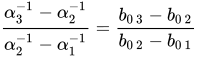
The condition for gauge coupling unification at one loop is whether the following expression is satisfied .
Remarkably, this is precisely satisfied to experimental errors in the values of . There are two loop corrections and both TeV-scale and GUT-scale threshold corrections that alter this condition on gauge coupling unification, and the results of more extensive calculations reveal that gauge coupling unification occurs to an accuracy of 1%, though this is about 3 standard deviations from the theoretical expectations.
This prediction is generally considered as indirect evidence for both the MSSM and SUSY GUTs.[10] Gauge coupling unification does not necessarily imply grand unification and there exist other mechanisms to reproduce gauge coupling unification. However, if superpartners are found in the near future, the apparent success of gauge coupling unification would suggest that a supersymmetric grand unified theory is a promising candidate for high scale physics.


MSSM fields[edit]
Fermions have bosonic superpartners (called sfermions), and bosons have fermionic superpartners (called bosinos). For most of the Standard Model particles, doubling is very straightforward. However, for the Higgs boson, it is more complicated.
A single Higgsino (the fermionic superpartner of the Higgs boson) would lead to a gauge anomaly and would cause the theory to be inconsistent. However, if two Higgsinos are added, there is no gauge anomaly. The simplest theory is one with two Higgsinos and therefore two scalar Higgs doublets. Another reason for having two scalar Higgs doublets rather than one is in order to have Yukawa couplings between the Higgs and both down-type quarks and up-type quarks; these are the terms responsible for the quarks' masses. In the Standard Model the down-type quarks couple to the Higgs field (which has Y=−12) and the up-type quarks to its complex conjugate (which has Y=+12). However, in a supersymmetric theory this is not allowed, so two types of Higgs fields are needed.
SM Particle type Particle Symbol Spin R-Parity Superpartner Symbol Spin R-parity Fermions Quark +1 Squark 0 −1 Lepton +1 Slepton 0 −1 Bosons W 1 +1 Wino −1 B 1 +1 Bino −1 Gluon 1 +1 Gluino −1 Higgs bosons Higgs 0 +1 Higgsinos −1


MSSM superfields[edit]
In supersymmetric theories, every field and its superpartner can be written together as a superfield. The superfield formulation of supersymmetry is very convenient to write down manifestly supersymmetric theories (i.e. one does not have to tediously check that the theory is supersymmetric term by term in the Lagrangian). The MSSM contains vector superfields associated with the Standard Model gauge groups which contain the vector bosons and associated gauginos. It also contains chiral superfields for the Standard Model fermions and Higgs bosons (and their respective superpartners).
field multiplicity representation Z2-parity Standard Model particle Q 3 − left-handed quark doublet Uc 3 − right-handed up-type anti-quark Dc 3 − right-handed down-type anti-quark L 3 − left-handed lepton doublet Ec 3 − right-handed anti-lepton Hu 1 + Higgs Hd 1 + Higgs


τοποθετώ • (topothetó) (past τοποθέτησα, passive τοποθετούμαι, p‑past τοποθετήθηκα, ppp τοποθετημένος)
Quantum electrodynamics
Quantum field theory 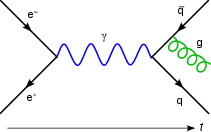
History
In particle physics, quantum electrodynamics (QED) is the relativistic quantum field theory of electrodynamics. In essence, it describes how light and matter interact and is the first theory where full agreement between quantum mechanics and special relativity is achieved. QED mathematically describes all phenomena involving electrically charged particles interacting by means of exchange of photons and represents the quantum counterpart of classical electromagnetism giving a complete account of matter and light interaction.
In technical terms, QED can be described as a perturbation theory of the electromagnetic quantum vacuum. Richard Feynman called it "the jewel of physics" for its extremely accurate predictions of quantities like the anomalous magnetic moment of the electron and the Lamb shift of the energy levels of hydrogen.[1]: Ch1
| Quantum field theory |
|---|
|
| History |
In particle physics, quantum electrodynamics (QED) is the relativistic quantum field theory of electrodynamics. In essence, it describes how light and matter interact and is the first theory where full agreement between quantum mechanics and special relativity is achieved. QED mathematically describes all phenomena involving electrically charged particles interacting by means of exchange of photons and represents the quantum counterpart of classical electromagnetism giving a complete account of matter and light interaction.
In technical terms, QED can be described as a perturbation theory of the electromagnetic quantum vacuum. Richard Feynman called it "the jewel of physics" for its extremely accurate predictions of quantities like the anomalous magnetic moment of the electron and the Lamb shift of the energy levels of hydrogen.[1]: Ch1


Topology


(Redirected from Topological)In mathematics, topology (from the Greek words τόπος, 'place, location', and λόγος, 'study') is concerned with the properties of a geometric object that are preserved under continuous deformations, such as stretching, twisting, crumpling, and bending; that is, without closing holes, opening holes, tearing, gluing, or passing through itself.
A topological space is a set endowed with a structure, called a topology, which allows defining continuous deformation of subspaces, and, more generally, all kinds of continuity. Euclidean spaces, and, more generally, metric spaces are examples of a topological space, as any distance or metric defines a topology. The deformations that are considered in topology are homeomorphisms and homotopies. A property that is invariant under such deformations is a topological property. Basic examples of topological properties are: the dimension, which allows distinguishing between a line and a surface; compactness, which allows distinguishing between a line and a circle; connectedness, which allows distinguishing a circle from two non-intersecting circles.
The ideas underlying topology go back to Gottfried Leibniz, who in the 17th century envisioned the geometria situs and analysis situs. Leonhard Euler's Seven Bridges of Königsberg problem and polyhedron formula are arguably the field's first theorems. The term topology was introduced by Johann Benedict Listing in the 19th century, although it was not until the first decades of the 20th century that the idea of a topological space was developed.

In mathematics, topology (from the Greek words τόπος, 'place, location', and λόγος, 'study') is concerned with the properties of a geometric object that are preserved under continuous deformations, such as stretching, twisting, crumpling, and bending; that is, without closing holes, opening holes, tearing, gluing, or passing through itself.
A topological space is a set endowed with a structure, called a topology, which allows defining continuous deformation of subspaces, and, more generally, all kinds of continuity. Euclidean spaces, and, more generally, metric spaces are examples of a topological space, as any distance or metric defines a topology. The deformations that are considered in topology are homeomorphisms and homotopies. A property that is invariant under such deformations is a topological property. Basic examples of topological properties are: the dimension, which allows distinguishing between a line and a surface; compactness, which allows distinguishing between a line and a circle; connectedness, which allows distinguishing a circle from two non-intersecting circles.
The ideas underlying topology go back to Gottfried Leibniz, who in the 17th century envisioned the geometria situs and analysis situs. Leonhard Euler's Seven Bridges of Königsberg problem and polyhedron formula are arguably the field's first theorems. The term topology was introduced by Johann Benedict Listing in the 19th century, although it was not until the first decades of the 20th century that the idea of a topological space was developed.

Contents
Group structure[edit]
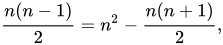
The groups O(n) and SO(n) are real compact Lie groups of dimension n(n − 1)/2. The group O(n) has two connected components, with SO(n) being the identity component, that is, the connected component containing the identity matrix.
As algebraic groups[edit]
The orthogonal group O(n) can be identified with the group of the matrices A such that Since both members of this equation are symmetric matrices, this provides equations that the entries of an orthogonal matrix must satisfy, and which are not all satisfied by the entries of any non-orthogonal matrix.
This proves that O(n) is an algebraic set. Moreover, it can be proved[citation needed] that its dimension is
which implies that O(n) is a complete intersection. This implies that all its irreducible components have the same dimension, and that it has no embedded component. In fact, O(n) has two irreducible components, that are distinguished by the sign of the determinant (that is det(A) = 1 or det(A) = –1). Both are nonsingular algebraic varieties of the same dimension n(n – 1) / 2. The component with det(A) = 1 is SO(n).


Symmetry group of spheres[edit]
The orthogonal group O(n) is the symmetry group of the (n − 1)-sphere (for n = 3, this is just the sphere) and all objects with spherical symmetry, if the origin is chosen at the center.
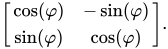
The symmetry group of a circle is O(2). The orientation-preserving subgroup SO(2) is isomorphic (as a real Lie group) to the circle group, also known as U(1), the multiplicative group of the complex numbers of absolute value equal to one. This isomorphism sends the complex number exp(φ i) = cos(φ) + i sin(φ) of absolute value 1 to the special orthogonal matrix
In higher dimension, O(n) has a more complicated structure (in particular, it is no longer commutative). The topological structures of the n-sphere and O(n) are strongly correlated, and this correlation is widely used for studying both topological spaces.
Circle group
| Algebraic structure → Group theory Group theory |
|---|
 |
| Lie groups |
|---|
 |
In mathematics, the circle group, denoted by or , is the multiplicative group of all complex numbers with absolute value 1, that is, the unit circle in the complex plane or simply the unit complex numbers[1]



The circle group forms a subgroup of , the multiplicative group of all nonzero complex numbers. Since is abelian, it follows that is as well.

A unit complex number in the circle group represents a rotation of the complex plane about the origin and can be parametrized by the angle measure :


This is the exponential map for the circle group.
The circle group plays a central role in Pontryagin duality and in the theory of Lie groups.
The notation for the circle group stems from the fact that, with the standard topology (see below), the circle group is a 1-torus. More generally, (the direct product of with itself times) is geometrically an -torus.


The circle group is isomorphic to the special orthogonal group .

Elementary introduction[edit]

One way to think about the circle group is that it describes how to add angles, where only angles between 0° and 360° are permitted. For example, the diagram illustrates how to add 150° to 270°. The answer should be 150° + 270° = 420°, but when thinking in terms of the circle group, we need to "forget" the fact that we have wrapped once around the circle. Therefore, we adjust our answer by 360°, which gives 420° = 60° (mod 360°).
Another description is in terms of ordinary addition, where only numbers between 0 and 1 are allowed (with 1 corresponding to a full rotation). To achieve this, we might need to throw away digits occurring before the decimal point. For example, when we work out 0.784 + 0.925 + 0.446, the answer should be 2.155, but we throw away the leading 2, so the answer (in the circle group) is just 0.155.
Topological and analytic structure[edit]
The circle group is more than just an abstract algebraic object. It has a natural topology when regarded as a subspace of the complex plane. Since multiplication and inversion are continuous functions on , the circle group has the structure of a topological group. Moreover, since the unit circle is a closed subset of the complex plane, the circle group is a closed subgroup of (itself regarded as a topological group).
One can say even more. The circle is a 1-dimensional real manifold, and multiplication and inversion are real-analytic maps on the circle. This gives the circle group the structure of a one-parameter group, an instance of a Lie group. In fact, up to isomorphism, it is the unique 1-dimensional compact, connected Lie group. Moreover, every -dimensional compact, connected, abelian Lie group is isomorphic to .
Isomorphisms[edit]
The circle group shows up in a variety of forms in mathematics. We list some of the more common forms here. Specifically, we show that

Note that the slash (/) denotes here quotient group.
Orthogonal group
Algebraic structure → Group theory
Group theory 
In mathematics, the orthogonal group in dimension n, denoted O(n), is the group of distance-preserving transformations of a Euclidean space of dimension n that preserve a fixed point, where the group operation is given by composing transformations. The orthogonal group is sometimes called the general orthogonal group, by analogy with the general linear group. Equivalently, it is the group of n×n orthogonal matrices, where the group operation is given by matrix multiplication (an orthogonal matrix is a real matrix whose inverse equals its transpose). The orthogonal group is an algebraic group and a Lie group. It is compact.
The orthogonal group in dimension n has two connected components. The one that contains the identity element is a normal subgroup, called the special orthogonal group, and denoted SO(n). It consists of all orthogonal matrices of determinant 1. This group is also called the rotation group, generalizing the fact that in dimensions 2 and 3, its elements are the usual rotations around a point (in dimension 2) or a line (in dimension 3). In low dimension, these groups have been widely studied, see SO(2), SO(3) and SO(4). The other component consists of all orthogonal matrices of determinant –1. This component does not form a group, as the product of any two of its elements is of determinant 1, and therefore not an element of the component.
By extension, for any field F, a n×n matrix with entries in F such that its inverse equals its transpose is called an orthogonal matrix over F. The n×n orthogonal matrices form a subgroup, denoted O(n, F), of the general linear group GL(n, F); that is
More generally, given a non-degenerate symmetric bilinear form or quadratic form[1] on a vector space over a field, the orthogonal group of the form is the group of invertible linear maps that preserve the form. The preceding orthogonal groups are the special case where, on some basis, the bilinear form is the dot product, or, equivalently, the quadratic form is the sum of the square of the coordinates.
All orthogonal groups are algebraic groups, since the condition of preserving a form can be expressed as an equality of matrices.
| Algebraic structure → Group theory Group theory |
|---|
|
In mathematics, the orthogonal group in dimension n, denoted O(n), is the group of distance-preserving transformations of a Euclidean space of dimension n that preserve a fixed point, where the group operation is given by composing transformations. The orthogonal group is sometimes called the general orthogonal group, by analogy with the general linear group. Equivalently, it is the group of n×n orthogonal matrices, where the group operation is given by matrix multiplication (an orthogonal matrix is a real matrix whose inverse equals its transpose). The orthogonal group is an algebraic group and a Lie group. It is compact.
The orthogonal group in dimension n has two connected components. The one that contains the identity element is a normal subgroup, called the special orthogonal group, and denoted SO(n). It consists of all orthogonal matrices of determinant 1. This group is also called the rotation group, generalizing the fact that in dimensions 2 and 3, its elements are the usual rotations around a point (in dimension 2) or a line (in dimension 3). In low dimension, these groups have been widely studied, see SO(2), SO(3) and SO(4). The other component consists of all orthogonal matrices of determinant –1. This component does not form a group, as the product of any two of its elements is of determinant 1, and therefore not an element of the component.
By extension, for any field F, a n×n matrix with entries in F such that its inverse equals its transpose is called an orthogonal matrix over F. The n×n orthogonal matrices form a subgroup, denoted O(n, F), of the general linear group GL(n, F); that is

More generally, given a non-degenerate symmetric bilinear form or quadratic form[1] on a vector space over a field, the orthogonal group of the form is the group of invertible linear maps that preserve the form. The preceding orthogonal groups are the special case where, on some basis, the bilinear form is the dot product, or, equivalently, the quadratic form is the sum of the square of the coordinates.
All orthogonal groups are algebraic groups, since the condition of preserving a form can be expressed as an equality of matrices.
Contents
Tangent half-angle formula
Trigonometry 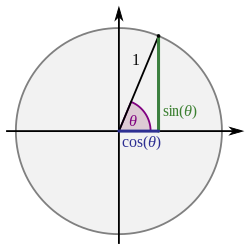
Reference Laws and theorems Calculus
In trigonometry, tangent half-angle formulas relate the tangent of half of an angle to trigonometric functions of the entire angle. The tangent of half an angle is the stereographic projection of the circle onto a line. Among these formulas are the following:
From these one can derive identities expressing the sine, cosine, and tangent as functions of tangents of half-angles:
|
| Trigonometry |
|---|
 |
| Reference |
| Laws and theorems |
| Calculus |
In trigonometry, tangent half-angle formulas relate the tangent of half of an angle to trigonometric functions of the entire angle. The tangent of half an angle is the stereographic projection of the circle onto a line. Among these formulas are the following:
![{\displaystyle {\begin{aligned}\tan {\tfrac {1}{2}}(\eta \pm \theta )&={\frac {\tan {\tfrac {1}{2}}\eta \pm \tan {\tfrac {1}{2}}\theta }{1\mp \tan {\tfrac {1}{2}}\eta \,\tan {\tfrac {1}{2}}\theta }}={\frac {\sin \eta \pm \sin \theta }{\cos \eta +\cos \theta }}=-{\frac {\cos \eta -\cos \theta }{\sin \eta \mp \sin \theta }},\\[10pt]\tan {\tfrac {1}{2}}\theta &={\frac {\sin \theta }{1+\cos \theta }}={\frac {\tan \theta }{\sec \theta +1}}={\frac {1}{\csc \theta +\cot \theta }},&&(\eta =0)\\[10pt]\tan {\tfrac {1}{2}}\theta &={\frac {1-\cos \theta }{\sin \theta }}={\frac {\sec \theta -1}{\tan \theta }}=\csc \theta -\cot \theta ,&&(\eta =0)\\[10pt]\tan {\tfrac {1}{2}}{\big (}\theta \pm {\tfrac {1}{2}}\pi {\big )}&={\frac {1\pm \sin \theta }{\cos \theta }}=\sec \theta \pm \tan \theta ={\frac {\csc \theta \pm 1}{\cot \theta }},&&{\big (}\eta ={\tfrac {1}{2}}\pi {\big )}\\[10pt]\tan {\tfrac {1}{2}}{\big (}\theta \pm {\tfrac {1}{2}}\pi {\big )}&={\frac {\cos \theta }{1\mp \sin \theta }}={\frac {1}{\sec \theta \mp \tan \theta }}={\frac {\cot \theta }{\csc \theta \mp 1}},&&{\big (}\eta ={\tfrac {1}{2}}\pi {\big )}\\[10pt]{\frac {1-\tan {\tfrac {1}{2}}\theta }{1+\tan {\tfrac {1}{2}}\theta }}&=\pm {\sqrt {\frac {1-\sin \theta }{1+\sin \theta }}}\\[10pt]\tan {\tfrac {1}{2}}\theta &=\pm {\sqrt {\frac {1-\cos \theta }{1+\cos \theta }}}\\[10pt]\end{aligned}}}](https://wikimedia.org/api/rest_v1/media/math/render/svg/84fb3ea7a5c8629322fc19a50d20c1448ee14f3a)
From these one can derive identities expressing the sine, cosine, and tangent as functions of tangents of half-angles:
![{\displaystyle {\begin{aligned}\sin \alpha &={\frac {2\tan {\tfrac {1}{2}}\alpha }{1+\tan ^{2}{\tfrac {1}{2}}\alpha }}\\[7pt]\cos \alpha &={\frac {1-\tan ^{2}{\tfrac {1}{2}}\alpha }{1+\tan ^{2}{\tfrac {1}{2}}\alpha }}\\[7pt]\tan \alpha &={\frac {2\tan {\tfrac {1}{2}}\alpha }{1-\tan ^{2}{\tfrac {1}{2}}\alpha }}\end{aligned}}}](https://wikimedia.org/api/rest_v1/media/math/render/svg/2f899c4e77dce03f2aef730fab0a3bf17cf5fd6a)
Contents
Abelian group
In mathematics, an abelian group, also called a commutative group, is a group in which the result of applying the group operation to two group elements does not depend on the order in which they are written. That is, the group operation is commutative. With addition as an operation, the integers and the real numbers form abelian groups, and the concept of an abelian group may be viewed as a generalization of these examples. Abelian groups are named after early 19th century mathematician Niels Henrik Abel.[1]
The concept of an abelian group underlies many fundamental algebraic structures, such as fields, rings, vector spaces, and algebras. The theory of abelian groups is generally simpler than that of their non-abelian counterparts, and finite abelian groups are very well understood and fully classified.
| Algebraic structure → Group theory Group theory |
|---|
|
Definition[edit]
An abelian group is a set , together with an operation that combines any two elements and of to form another element of denoted . The symbol is a general placeholder for a concretely given operation. To qualify as an abelian group, the set and operation, , must satisfy four requirements known as the abelian group axioms (some authors include in the axioms some properties that belong to the definition of an operation: namely that the operation is defined for any ordered pair of elements of A, that the result is well-defined, and that the result belongs to A):


- Associativity
- For all , , and in , the equation holds.
- Identity element
- There exists an element in , such that for all elements in , the equation holds.
- Inverse element
- For each in there exists an element in such that , where is the identity element.
- Commutativity
- For all , in , .






A group in which the group operation is not commutative is called a "non-abelian group" or "non-commutative group".[2]: 11
Facts[edit]
Notation[edit]
There are two main notational conventions for abelian groups – additive and multiplicative.
| Convention | Operation | Identity | Powers | Inverse |
|---|---|---|---|---|
| Addition | 0 | |||
| Multiplication | or | 1 |


Generally, the multiplicative notation is the usual notation for groups, while the additive notation is the usual notation for modules and rings. The additive notation may also be used to emphasize that a particular group is abelian, whenever both abelian and non-abelian groups are considered, some notable exceptions being near-rings and partially ordered groups, where an operation is written additively even when non-abelian.[3]: 28–29
Classification[edit]
The fundamental theorem of finite abelian groups states that every finite abelian group can be expressed as the direct sum of cyclic subgroups of prime-power order; it is also known as the basis theorem for finite abelian groups. Moreover, automorphism groups of cyclic groups are examples of abelian groups.[10] This is generalized by the fundamental theorem of finitely generated abelian groups, with finite groups being the special case when G has zero rank; this in turn admits numerous further generalizations.
The classification was proven by Leopold Kronecker in 1870, though it was not stated in modern group-theoretic terms until later, and was preceded by a similar classification of quadratic forms by Carl Friedrich Gauss in 1801; see history for details.
The cyclic group of order is isomorphic to the direct sum of and if and only if and are coprime. It follows that any finite abelian group is isomorphic to a direct sum of the form
in either of the following canonical ways:
- the numbers are powers of (not necessarily distinct) primes,
- or divides , which divides , and so on up to .
For example, can be expressed as the direct sum of two cyclic subgroups of order 3 and 5: . The same can be said for any abelian group of order 15, leading to the remarkable conclusion that all abelian groups of order 15 are isomorphic.
For another example, every abelian group of order 8 is isomorphic to either (the integers 0 to 7 under addition modulo 8), (the odd integers 1 to 15 under multiplication modulo 16), or .
See also list of small groups for finite abelian groups of order 30 or less.









Multiplication table[edit]
To verify that a finite group is abelian, a table (matrix) – known as a Cayley table – can be constructed in a similar fashion to a multiplication table.[4]: 10 If the group is under the operation , the -th entry of this table contains the product .
The group is abelian if and only if this table is symmetric about the main diagonal. This is true since the group is abelian iff for all , which is iff the entry of the table equals the entry for all , i.e. the table is symmetric about the main diagonal.






Examples[edit]
- For the integers and the operation addition , denoted , the operation + combines any two integers to form a third integer, addition is associative, zero is the additive identity, every integer has an additive inverse, , and the addition operation is commutative since for any two integers and .
- Every cyclic group is abelian, because if , are in , then . Thus the integers, , form an abelian group under addition, as do the integers modulo , .
- Every ring is an abelian group with respect to its addition operation. In a commutative ring the invertible elements, or units, form an abelian multiplicative group. In particular, the real numbers are an abelian group under addition, and the nonzero real numbers are an abelian group under multiplication.
- Every subgroup of an abelian group is normal, so each subgroup gives rise to a quotient group. Subgroups, quotients, and direct sums of abelian groups are again abelian. The finite simple abelian groups are exactly the cyclic groups of prime order.[5]
- The concepts of abelian group and -module agree. More specifically, every -module is an abelian group with its operation of addition, and every abelian group is a module over the ring of integers in a unique way.
In general, matrices, even invertible matrices, do not form an abelian group under multiplication because matrix multiplication is generally not commutative. However, some groups of matrices are abelian groups under matrix multiplication – one example is the group of rotation matrices.








Non-abelian group
Algebraic structure → Group theory
Group theory
In mathematics, and specifically in group theory, a non-abelian group, sometimes called a non-commutative group, is a group (G, ∗) in which there exists at least one pair of elements a and b of G, such that a ∗ b ≠ b ∗ a.[1][2] This class of groups contrasts with the abelian groups. (In an abelian group, all pairs of group elements commute).
Non-abelian groups are pervasive in mathematics and physics. One of the simplest examples of a non-abelian group is the dihedral group of order 6. It is the smallest finite non-abelian group. A common example from physics is the rotation group SO(3) in three dimensions (for example, rotating something 90 degrees along one axis and then 90 degrees along a different axis is not the same as doing them in reverse order).
Both discrete groups and continuous groups may be non-abelian. Most of the interesting Lie groups are non-abelian, and these play an important role in gauge theory.
| Algebraic structure → Group theory Group theory |
|---|
|
In mathematics, and specifically in group theory, a non-abelian group, sometimes called a non-commutative group, is a group (G, ∗) in which there exists at least one pair of elements a and b of G, such that a ∗ b ≠ b ∗ a.[1][2] This class of groups contrasts with the abelian groups. (In an abelian group, all pairs of group elements commute).
Non-abelian groups are pervasive in mathematics and physics. One of the simplest examples of a non-abelian group is the dihedral group of order 6. It is the smallest finite non-abelian group. A common example from physics is the rotation group SO(3) in three dimensions (for example, rotating something 90 degrees along one axis and then 90 degrees along a different axis is not the same as doing them in reverse order).
Both discrete groups and continuous groups may be non-abelian. Most of the interesting Lie groups are non-abelian, and these play an important role in gauge theory.
See also[edit]
References[edit]
- ^ Dummit, David S.; Foote, Richard M. (2004). Abstract Algebra (3rd ed.). John Wiley & Sons. ISBN 0-471-43334-9.
- ^ Dummit, David S.; Foote, Richard M. (2004). Abstract Algebra (3rd ed.). John Wiley & Sons. ISBN 0-471-43334-9.
Quantum electrodynamics
| Quantum field theory |
|---|
|
| History |
In particle physics, quantum electrodynamics (QED) is the relativistic quantum field theory of electrodynamics. In essence, it describes how light and matter interact and is the first theory where full agreement between quantum mechanics and special relativity is achieved. QED mathematically describes all phenomena involving electrically charged particles interacting by means of exchange of photons and represents the quantum counterpart of classical electromagnetism giving a complete account of matter and light interaction.


Guillotine
| This article needs additional citations for verification. (April 2017) |

A guillotine is an apparatus designed for efficiently carrying out executions by beheading. The device consists of a tall, upright frame with a weighted and angled blade suspended at the top. The condemned person is secured with stocks at the bottom of the frame, positioning the neck directly below the blade. The blade is then released, swiftly and forcefully decapitating the victim with a single, clean pass so that the head falls into a basket or other receptacle below.
The guillotine is best known for its use in France, particularly during the French Revolution, where the revolution's supporters celebrated it as the people's avenger and the revolution's opponents vilified it as the pre-eminent symbol of the violence of the Reign of Terror.[1] While the name "guillotine" itself dates from this period, similar devices had been in use elsewhere in Europe over several centuries. The use of an oblique blade and the stocks set this type of guillotine apart from others. The display of severed heads had long been one of the most common ways European sovereigns exhibited their power to their subjects.[2]
The guillotine was invented in order to make capital punishment less painful in accordance with new Enlightenment ideals about human rights. Prior to the guillotine, France had used manual beheading alongside a variety of methods of execution, many of which were more gruesome and required a high level of precision and skill to carry out successfully. After its adoption, the device remained France's standard method of judicial execution until the abolition of capital punishment in 1981.[3] The last person to be executed in France was Hamida Djandoubi, guillotined on 10 September 1977.[4]
History[edit]
Precursors[edit]

The use of beheading machines in Europe long predates such use during the French Revolution in 1792. An early example of the principle is found in the High History of the Holy Grail, dated to about 1210. Although the device is imaginary, its function is clear.[5] The text says:
The Halifax Gibbet was a wooden structure consisting of two wooden uprights, capped by a horizontal beam, of a total height of 4.5 metres (15 ft). The blade was an axe head weighing 3.5 kg (7.7 lb), attached to the bottom of a massive wooden block that slid up and down in grooves in the uprights. This device was mounted on a large square platform 1.25 metres (4 ft) high. It is not known when the Halifax Gibbet was first used; the first recorded execution in Halifax dates from 1280, but that execution may have been by sword, axe, or gibbet. The machine remained in use until Oliver Cromwell forbade capital punishment for petty theft.
A Hans Weiditz (1495-1537) woodcut illustration from the 1532 edition of Petrarch's De remediis utriusque fortunae, or "Remedies for Both Good and Bad Fortune" shows a device similar to the Halifax Gibbet in the background being used for an execution.
Holinshed's Chronicles of 1577 included a picture of "The execution of Murcod Ballagh near Merton in Ireland in 1307" showing a similar execution machine, suggesting its early use in Ireland.[6]
The Maiden was constructed in 1564 for the Provost and Magistrates of Edinburgh, and was in use from April 1565 to 1710. One of those executed was James Douglas, 4th Earl of Morton, in 1581, and a 1644 publication began circulating the legend that Morton himself commissioned the Maiden after he had seen the Halifax Gibbet.[7] The Maiden was readily dismantled for storage and transport, and it is now on display in the National Museum of Scotland.[8]
France[edit]
Etymology[edit]
For a period of time after its invention, the guillotine was called a louisette. However, it was later named after French physician and Freemason Joseph-Ignace Guillotin, who proposed on 10 October 1789 the use of a special device to carry out executions in France in a more humane manner. A death penalty opponent, he was displeased with the breaking wheel and other common, more grisly methods of execution and sought to persuade Louis XVI of France to implement a less painful alternative. While not the device's inventor, Guillotin's name ultimately became an eponym for it. Contrary to popular myth, Guillotin did not die by guillotine but rather by natural causes.[9]
Invention[edit]
French surgeon and physiologist Antoine Louis, together with German engineer Tobias Schmidt, built a prototype for the guillotine. According to the memoires of the French executioner Charles-Henri Sanson, Louis XVI suggested the use of a straight, angled blade instead of a curved one.[10]
Introduction in France[edit]
,_m%C3%A9decin_et_homme_politique._-_P1052_-_Mus%C3%A9e_Carnavalet_(cropped).jpg)
On 10 October 1789, physician Joseph-Ignace Guillotin proposed to the National Assembly that capital punishment should always take the form of decapitation "by means of a simple mechanism".[11]
Sensing the growing discontent, Louis XVI banned the use of the breaking wheel.[12] In 1791, as the French Revolution progressed, the National Assembly researched a new method to be used on all condemned people regardless of class, consistent with the idea that the purpose of capital punishment was simply to end life rather than to inflict unnecessary pain.[12]
A committee formed under Antoine Louis, physician to the King and Secretary to the Academy of Surgery.[12] Guillotin was also on the committee. The group was influenced by beheading devices used elsewhere in Europe, such as the Italian Mannaia (or Mannaja, which had been used since Roman times[citation needed]), the Scottish Maiden, and the Halifax Gibbet (3.5 kg).[13] While many of these prior instruments crushed the neck or used blunt force to take off a head, a number of them also used a crescent blade to behead and a hinged two-part yoke to immobilize the victim's neck.[12]
Laquiante, an officer of the Strasbourg criminal court,[14] designed a beheading machine and employed Tobias Schmidt, a German engineer and harpsichord maker, to construct a prototype.[15] Antoine Louis is also credited with the design of the prototype. France's official executioner, Charles-Henri Sanson, claimed in his memoirs that King Louis XVI (an amateur locksmith) recommended that the device employ an oblique blade rather than a crescent one, lest the blade not be able to cut through all necks; the neck of the king, who would eventually die by guillotine years later, was offered up discreetly as an example.[16] The first execution by guillotine was performed on highwayman Nicolas Jacques Pelletier[17] on 25 April 1792[18][19][20] in front of what is now the city hall of Paris (Place de l'Hôtel de Ville). All citizens condemned to die were from then on executed there, until the scaffold was moved on 21 August to the Place du Carrousel.
The machine was deemed successful because it was considered a humane form of execution in contrast with the more cruel methods used in the pre-revolutionary Ancien Régime. In France, before the invention of the guillotine, members of the nobility were beheaded with a sword or an axe, which often took two or more blows to kill the condemned. The condemned or their families would sometimes pay the executioner to ensure that the blade was sharp in order to achieve a quick and relatively painless death. Commoners were usually hanged, which could take many minutes. In the early phase of the French Revolution before the guillotine's adoption, the slogan À la lanterne (in English: To the lamp post! String Them Up! or Hang Them!) symbolized popular justice in revolutionary France. The revolutionary radicals hanged officials and aristocrats from street lanterns and also employed more gruesome methods of execution, such as the wheel or burning at the stake.
Having only one method of civil execution for all regardless of class was also seen as an expression of equality among citizens. The guillotine was then the only civil legal execution method in France until the abolition of the death penalty in 1981,[21] apart from certain crimes against the security of the state, or for the death sentences passed by military courts,[22] which entailed execution by firing squad.[23]
Reign of Terror[edit]


Louis Collenot d'Angremont was a royalist famed for having been the first guillotined for his political ideas, on 21 August 1792. During the Reign of Terror (June 1793 to July 1794) about 17,000 people were guillotined, including former King Louis XVI and Queen Marie Antoinette who were executed at the guillotine in 1793. Towards the end of the Terror in 1794, revolutionary leaders such as Georges Danton, Saint-Just and Maximilien Robespierre were sent to the guillotine. Most of the time, executions in Paris were carried out in the Place de la Revolution (former Place Louis XV and current Place de la Concorde); the guillotine stood in the corner near the Hôtel Crillon where the City of Brest Statue can be found today. The machine was moved several times, to the Place de la Nation and the Place de la Bastille, but returned, particularly for the execution of the King and for Robespierre.
For a time, executions by guillotine were a popular form of entertainment that attracted great crowds of spectators, with vendors selling programs listing the names of the condemned. But more than being popular entertainment alone during the Terror, the guillotine symbolized revolutionary ideals: equality in death equivalent to equality before the law; open and demonstrable revolutionary justice; and the destruction of privilege under the Ancien Régime, which used separate forms of execution for nobility and commoners.[24] The Parisian sans-culottes, then the popular public face of lower-class patriotic radicalism, thus considered the guillotine a positive force for revolutionary progress.[25]
Retirement[edit]

After the French Revolution, executions resumed in the city center. On 4 February 1832, the guillotine was moved behind the Church of Saint-Jacques-de-la-Boucherie, before being moved again, to the Grande Roquette prison, on 29 November 1851.
In the late 1840s, the Tussaud brothers Joseph and Francis, gathering relics for Madame Tussauds wax museum, visited the aged Henry-Clément Sanson, grandson of the executioner Charles-Henri Sanson, from whom they obtained parts, the knife and lunette, of one of the original guillotines used during the Reign of Terror. The executioner had "pawned his guillotine, and got into woeful trouble for alleged trafficking in municipal property".[26]
On 6 August 1909, the guillotine was used at the junction of the Boulevard Arago and the Rue de la Santé, behind the La Santé Prison.
The last public guillotining in France was of Eugen Weidmann, who was convicted of six murders. He was beheaded on 17 June 1939 outside the prison Saint-Pierre, rue Georges Clemenceau 5 at Versailles, which is now the Palais de Justice. Numerous issues with the proceedings arose: inappropriate behavior by spectators, incorrect assembly of the apparatus, and secret cameras filming and photographing the execution from several storeys above. In response, the French government ordered that future executions be conducted in the prison courtyard in private.[citation needed]
The guillotine remained the official method of execution in France until the death penalty was abolished in 1981.[3] The final three guillotinings in France before its abolition were those of child-murderers Christian Ranucci (on 28 July 1976) in Marseille, Jérôme Carrein (on 23 June 1977) in Douai and torturer-murderer Hamida Djandoubi (on 10 September 1977) in Marseille. Djandoubi's death was the last time that the guillotine was used for an execution by any government.
Germany[edit]
In Germany, the guillotine is known as the Fallbeil ("falling hatchet") or Köpfsmaschine ("head [cutting] machine") and was used in various German states from the 19th century onwards,[citation needed] becoming the preferred method of execution in Napoleonic times in many parts of the country. The guillotine and the firing squad were the legal methods of execution during the era of the German Empire (1871–1918) and the Weimar Republic (1919–1933).
The original German guillotines resembled the French Berger 1872 model, but they eventually evolved into sturdier and more efficient machines. Built primarily of metal instead of wood, these new guillotines had heavier blades than their French predecessors and thus could use shorter uprights as well. Officials could also conduct multiple executions faster, thanks to a more efficient blade recovery system and the eventual removal of the tilting board (bascule). Those deemed likely to struggle were backed slowly into the device from behind a curtain to prevent them from seeing it prior to the execution. A metal screen covered the blade as well in order to conceal it from the sight of the condemned.
Nazi Germany used the guillotine between 1933 and 1945 to execute 16,500 prisoners – 10,000 of them in 1944 and 1945 alone.[27][28] One political victim the government guillotined was Sophie Scholl, who was convicted of high treason after distributing anti-Nazi pamphlets at the University of Munich with her brother Hans, and other members of the German student resistance group, the White Rose.[29][citation needed] The guillotine was last used in West Germany in 1949 in the execution of Richard Schuh[30] and was last used in East Germany in 1966 in the execution of Horst Fischer.[31] The Stasi used the guillotine in East Germany between 1950 and 1966 for secret executions.[32]
Sophie Scholl
Sophia Magdalena Scholl  Sophie Scholl in 1942
Born Sophia Magdalena Scholl
9 May 1921
Died 22 February 1943 (aged 21)
Cause of death Execution by guillotine Resting place Cemetery at Perlacher Forst, Munich, Germany
48.097344°N 11.59949°E Nationality German Education Ludwig Maximilian University of Munich Occupation Student, political activist Parents - Robert Scholl
- Magdalena Scholl
Relatives - Inge Scholl (sister)
- Hans Scholl (brother)
- Elisabeth Hartnagel (sister)
- Werner Scholl (brother)
Sophia Magdalena Scholl[a] (9 May 1921 – 22 February 1943) was a German student and anti-Nazi political activist, active within the White Rose non-violent resistance group in Nazi Germany.[1][2]
She was convicted of high treason after having been found distributing anti-war leaflets at the University of Munich (LMU) with her brother, Hans. For her actions, she was executed by guillotine. Since the 1970s, Scholl has been extensively commemorated for her anti-Nazi resistance work.
Sophia Magdalena Scholl | |
|---|---|
 Sophie Scholl in 1942 | |
| Born | Sophia Magdalena Scholl 9 May 1921 |
| Died | 22 February 1943 (aged 21) |
| Cause of death | Execution by guillotine |
| Resting place | Cemetery at Perlacher Forst, Munich, Germany 48.097344°N 11.59949°E |
| Nationality | German |
| Education | Ludwig Maximilian University of Munich |
| Occupation | Student, political activist |
| Parents |
|
| Relatives |
|

Sophia Magdalena Scholl[a] (9 May 1921 – 22 February 1943) was a German student and anti-Nazi political activist, active within the White Rose non-violent resistance group in Nazi Germany.[1][2]
She was convicted of high treason after having been found distributing anti-war leaflets at the University of Munich (LMU) with her brother, Hans. For her actions, she was executed by guillotine. Since the 1970s, Scholl has been extensively commemorated for her anti-Nazi resistance work.
Contents
Early life[edit]
Scholl was the daughter of Magdalena (née Müller) and Robert Scholl, a liberal politician, and ardent Nazi critic, who was the mayor of her hometown of Forchtenberg am Kocher in the Free People's State of Württemberg at the time of her birth. She was the fourth of six children:
- Inge Aicher-Scholl (1917–1998)[3][4][5]
- Hans Scholl (1918–1943)
- Elisabeth Hartnagel-Scholl (27 February 1920 – 28 February 2020), married Sophie's long-term boyfriend, Fritz Hartnagel[6][7]
- Sophie Scholl (1921–1943)
- Werner Scholl (1922–1944) missing in action and presumed dead in June 1944
- Thilde Scholl (1925–1926)
Scholl was brought up in the Lutheran church. She entered junior or grade school at the age of seven, learned easily, and had a carefree childhood. In 1930, the family moved to Ludwigsburg and then two years later to Ulm where her father had a business consulting office.
In 1932, Scholl began attending a secondary school for girls. At the age of 12, she chose to join the Bund Deutscher Mädel (League of German Girls), as did most of her classmates. Her initial enthusiasm gradually gave way to criticism. She was aware of the dissenting political views of her father, friends, and some teachers. Her own brother Hans, who once eagerly participated in the Hitler Youth program, became entirely disillusioned with the Nazi Party.[8] Political attitude had become an essential criterion in her choice of friends. The arrest of her brothers and friends in 1937 for participating in the German Youth Movement left a strong impression on her.
She had a talent for drawing and painting and for the first time, came into contact with a few so-called "degenerate" artists. An avid reader, she developed a growing interest in philosophy and theology.
In spring 1940, she graduated from secondary school, where the subject of her essay was "The Hand that Moved the Cradle, Moved the World, a poem by William Ross Wallace." Scholl almost did not graduate, having lost all desire to participate in the classes which had largely become Nazi indoctrination.[8] Being fond of children, she became a kindergarten teacher at the Fröbel Institute in Ulm. She had also chosen this job hoping that it would be recognized as an alternative service in the Reichsarbeitsdienst (National Labor Service), a prerequisite for admission to university. This was not the case and in spring 1941 she began a six-month stint in the auxiliary war service as a nursery teacher in Blumberg. The military-like regimen of the Labor Service caused her to rethink her understanding of the political situation and to begin practising passive resistance.
After her six months in the National Labor Service, in May 1942, she enrolled at the University of Munich as a student of biology and philosophy.[9] Her brother Hans, who was studying medicine at the same institution, introduced her to his friends. Although this group of friends eventually was known for their political views, they initially were drawn together by a shared love of art, music, literature, philosophy, and theology. Hiking in the mountains, skiing, and swimming were also of importance to them. They often attended concerts, plays, and lectures together.
In Munich, Scholl met a number of artists, writers, and philosophers, particularly Carl Muth and Theodor Haecker, who were important contacts for her. The question they pondered the most was how the individual must act under a dictatorship. During the summer vacation in 1942, Scholl had to do war service in a metallurgical plant in Ulm. At the same time, her father was serving time in prison for having made a critical remark to an employee about Adolf Hitler.[10]

Scholl was the daughter of Magdalena (née Müller) and Robert Scholl, a liberal politician, and ardent Nazi critic, who was the mayor of her hometown of Forchtenberg am Kocher in the Free People's State of Württemberg at the time of her birth. She was the fourth of six children:
- Inge Aicher-Scholl (1917–1998)[3][4][5]
- Hans Scholl (1918–1943)
- Elisabeth Hartnagel-Scholl (27 February 1920 – 28 February 2020), married Sophie's long-term boyfriend, Fritz Hartnagel[6][7]
- Sophie Scholl (1921–1943)
- Werner Scholl (1922–1944) missing in action and presumed dead in June 1944
- Thilde Scholl (1925–1926)
Scholl was brought up in the Lutheran church. She entered junior or grade school at the age of seven, learned easily, and had a carefree childhood. In 1930, the family moved to Ludwigsburg and then two years later to Ulm where her father had a business consulting office.

In 1932, Scholl began attending a secondary school for girls. At the age of 12, she chose to join the Bund Deutscher Mädel (League of German Girls), as did most of her classmates. Her initial enthusiasm gradually gave way to criticism. She was aware of the dissenting political views of her father, friends, and some teachers. Her own brother Hans, who once eagerly participated in the Hitler Youth program, became entirely disillusioned with the Nazi Party.[8] Political attitude had become an essential criterion in her choice of friends. The arrest of her brothers and friends in 1937 for participating in the German Youth Movement left a strong impression on her.
She had a talent for drawing and painting and for the first time, came into contact with a few so-called "degenerate" artists. An avid reader, she developed a growing interest in philosophy and theology.
In spring 1940, she graduated from secondary school, where the subject of her essay was "The Hand that Moved the Cradle, Moved the World, a poem by William Ross Wallace." Scholl almost did not graduate, having lost all desire to participate in the classes which had largely become Nazi indoctrination.[8] Being fond of children, she became a kindergarten teacher at the Fröbel Institute in Ulm. She had also chosen this job hoping that it would be recognized as an alternative service in the Reichsarbeitsdienst (National Labor Service), a prerequisite for admission to university. This was not the case and in spring 1941 she began a six-month stint in the auxiliary war service as a nursery teacher in Blumberg. The military-like regimen of the Labor Service caused her to rethink her understanding of the political situation and to begin practising passive resistance.
After her six months in the National Labor Service, in May 1942, she enrolled at the University of Munich as a student of biology and philosophy.[9] Her brother Hans, who was studying medicine at the same institution, introduced her to his friends. Although this group of friends eventually was known for their political views, they initially were drawn together by a shared love of art, music, literature, philosophy, and theology. Hiking in the mountains, skiing, and swimming were also of importance to them. They often attended concerts, plays, and lectures together.
In Munich, Scholl met a number of artists, writers, and philosophers, particularly Carl Muth and Theodor Haecker, who were important contacts for her. The question they pondered the most was how the individual must act under a dictatorship. During the summer vacation in 1942, Scholl had to do war service in a metallurgical plant in Ulm. At the same time, her father was serving time in prison for having made a critical remark to an employee about Adolf Hitler.[10]

Tangent half-angle formula
Trigonometry Reference Laws and theorems Calculus
In trigonometry, tangent half-angle formulas relate the tangent of half of an angle to trigonometric functions of the entire angle. The tangent of half an angle is the stereographic projection of the circle onto a line. Among these formulas are the following:
From these one can derive identities expressing the sine, cosine, and tangent as functions of tangents of half-angles:
|
| Trigonometry |
|---|
|
| Reference |
| Laws and theorems |
| Calculus |
In trigonometry, tangent half-angle formulas relate the tangent of half of an angle to trigonometric functions of the entire angle. The tangent of half an angle is the stereographic projection of the circle onto a line. Among these formulas are the following:
From these one can derive identities expressing the sine, cosine, and tangent as functions of tangents of half-angles:
Contents
Guillotine
| This article needs additional citations for verification. (April 2017) |
A guillotine is an apparatus designed for efficiently carrying out executions by beheading. The device consists of a tall, upright frame with a weighted and angled blade suspended at the top. The condemned person is secured with stocks at the bottom of the frame, positioning the neck directly below the blade. The blade is then released, swiftly and forcefully decapitating the victim with a single, clean pass so that the head falls into a basket or other receptacle below.
The guillotine is best known for its use in France, particularly during the French Revolution, where the revolution's supporters celebrated it as the people's avenger and the revolution's opponents vilified it as the pre-eminent symbol of the violence of the Reign of Terror.[1] While the name "guillotine" itself dates from this period, similar devices had been in use elsewhere in Europe over several centuries. The use of an oblique blade and the stocks set this type of guillotine apart from others. The display of severed heads had long been one of the most common ways European sovereigns exhibited their power to their subjects.[2]
The guillotine was invented in order to make capital punishment less painful in accordance with new Enlightenment ideals about human rights. Prior to the guillotine, France had used manual beheading alongside a variety of methods of execution, many of which were more gruesome and required a high level of precision and skill to carry out successfully. After its adoption, the device remained France's standard method of judicial execution until the abolition of capital punishment in 1981.[3] The last person to be executed in France was Hamida Djandoubi, guillotined on 10 September 1977.[4]
History[edit]
Precursors[edit]
The use of beheading machines in Europe long predates such use during the French Revolution in 1792. An early example of the principle is found in the High History of the Holy Grail, dated to about 1210. Although the device is imaginary, its function is clear.[5] The text says:
The Halifax Gibbet was a wooden structure consisting of two wooden uprights, capped by a horizontal beam, of a total height of 4.5 metres (15 ft). The blade was an axe head weighing 3.5 kg (7.7 lb), attached to the bottom of a massive wooden block that slid up and down in grooves in the uprights. This device was mounted on a large square platform 1.25 metres (4 ft) high. It is not known when the Halifax Gibbet was first used; the first recorded execution in Halifax dates from 1280, but that execution may have been by sword, axe, or gibbet. The machine remained in use until Oliver Cromwell forbade capital punishment for petty theft.
A Hans Weiditz (1495-1537) woodcut illustration from the 1532 edition of Petrarch's De remediis utriusque fortunae, or "Remedies for Both Good and Bad Fortune" shows a device similar to the Halifax Gibbet in the background being used for an execution.
Holinshed's Chronicles of 1577 included a picture of "The execution of Murcod Ballagh near Merton in Ireland in 1307" showing a similar execution machine, suggesting its early use in Ireland.[6]
The Maiden was constructed in 1564 for the Provost and Magistrates of Edinburgh, and was in use from April 1565 to 1710. One of those executed was James Douglas, 4th Earl of Morton, in 1581, and a 1644 publication began circulating the legend that Morton himself commissioned the Maiden after he had seen the Halifax Gibbet.[7] The Maiden was readily dismantled for storage and transport, and it is now on display in the National Museum of Scotland.[8]
France[edit]
Etymology[edit]
For a period of time after its invention, the guillotine was called a louisette. However, it was later named after French physician and Freemason Joseph-Ignace Guillotin, who proposed on 10 October 1789 the use of a special device to carry out executions in France in a more humane manner. A death penalty opponent, he was displeased with the breaking wheel and other common, more grisly methods of execution and sought to persuade Louis XVI of France to implement a less painful alternative. While not the device's inventor, Guillotin's name ultimately became an eponym for it. Contrary to popular myth, Guillotin did not die by guillotine but rather by natural causes.[9]
Invention[edit]
French surgeon and physiologist Antoine Louis, together with German engineer Tobias Schmidt, built a prototype for the guillotine. According to the memoires of the French executioner Charles-Henri Sanson, Louis XVI suggested the use of a straight, angled blade instead of a curved one.[10]
Introduction in France[edit]
On 10 October 1789, physician Joseph-Ignace Guillotin proposed to the National Assembly that capital punishment should always take the form of decapitation "by means of a simple mechanism".[11]
Sensing the growing discontent, Louis XVI banned the use of the breaking wheel.[12] In 1791, as the French Revolution progressed, the National Assembly researched a new method to be used on all condemned people regardless of class, consistent with the idea that the purpose of capital punishment was simply to end life rather than to inflict unnecessary pain.[12]
A committee formed under Antoine Louis, physician to the King and Secretary to the Academy of Surgery.[12] Guillotin was also on the committee. The group was influenced by beheading devices used elsewhere in Europe, such as the Italian Mannaia (or Mannaja, which had been used since Roman times[citation needed]), the Scottish Maiden, and the Halifax Gibbet (3.5 kg).[13] While many of these prior instruments crushed the neck or used blunt force to take off a head, a number of them also used a crescent blade to behead and a hinged two-part yoke to immobilize the victim's neck.[12]
Laquiante, an officer of the Strasbourg criminal court,[14] designed a beheading machine and employed Tobias Schmidt, a German engineer and harpsichord maker, to construct a prototype.[15] Antoine Louis is also credited with the design of the prototype. France's official executioner, Charles-Henri Sanson, claimed in his memoirs that King Louis XVI (an amateur locksmith) recommended that the device employ an oblique blade rather than a crescent one, lest the blade not be able to cut through all necks; the neck of the king, who would eventually die by guillotine years later, was offered up discreetly as an example.[16] The first execution by guillotine was performed on highwayman Nicolas Jacques Pelletier[17] on 25 April 1792[18][19][20] in front of what is now the city hall of Paris (Place de l'Hôtel de Ville). All citizens condemned to die were from then on executed there, until the scaffold was moved on 21 August to the Place du Carrousel.
The machine was deemed successful because it was considered a humane form of execution in contrast with the more cruel methods used in the pre-revolutionary Ancien Régime. In France, before the invention of the guillotine, members of the nobility were beheaded with a sword or an axe, which often took two or more blows to kill the condemned. The condemned or their families would sometimes pay the executioner to ensure that the blade was sharp in order to achieve a quick and relatively painless death. Commoners were usually hanged, which could take many minutes. In the early phase of the French Revolution before the guillotine's adoption, the slogan À la lanterne (in English: To the lamp post! String Them Up! or Hang Them!) symbolized popular justice in revolutionary France. The revolutionary radicals hanged officials and aristocrats from street lanterns and also employed more gruesome methods of execution, such as the wheel or burning at the stake.
Having only one method of civil execution for all regardless of class was also seen as an expression of equality among citizens. The guillotine was then the only civil legal execution method in France until the abolition of the death penalty in 1981,[21] apart from certain crimes against the security of the state, or for the death sentences passed by military courts,[22] which entailed execution by firing squad.[23]
Reign of Terror[edit]
Louis Collenot d'Angremont was a royalist famed for having been the first guillotined for his political ideas, on 21 August 1792. During the Reign of Terror (June 1793 to July 1794) about 17,000 people were guillotined, including former King Louis XVI and Queen Marie Antoinette who were executed at the guillotine in 1793. Towards the end of the Terror in 1794, revolutionary leaders such as Georges Danton, Saint-Just and Maximilien Robespierre were sent to the guillotine. Most of the time, executions in Paris were carried out in the Place de la Revolution (former Place Louis XV and current Place de la Concorde); the guillotine stood in the corner near the Hôtel Crillon where the City of Brest Statue can be found today. The machine was moved several times, to the Place de la Nation and the Place de la Bastille, but returned, particularly for the execution of the King and for Robespierre.
For a time, executions by guillotine were a popular form of entertainment that attracted great crowds of spectators, with vendors selling programs listing the names of the condemned. But more than being popular entertainment alone during the Terror, the guillotine symbolized revolutionary ideals: equality in death equivalent to equality before the law; open and demonstrable revolutionary justice; and the destruction of privilege under the Ancien Régime, which used separate forms of execution for nobility and commoners.[24] The Parisian sans-culottes, then the popular public face of lower-class patriotic radicalism, thus considered the guillotine a positive force for revolutionary progress.[25]

Retirement[edit]
After the French Revolution, executions resumed in the city center. On 4 February 1832, the guillotine was moved behind the Church of Saint-Jacques-de-la-Boucherie, before being moved again, to the Grande Roquette prison, on 29 November 1851.
In the late 1840s, the Tussaud brothers Joseph and Francis, gathering relics for Madame Tussauds wax museum, visited the aged Henry-Clément Sanson, grandson of the executioner Charles-Henri Sanson, from whom they obtained parts, the knife and lunette, of one of the original guillotines used during the Reign of Terror. The executioner had "pawned his guillotine, and got into woeful trouble for alleged trafficking in municipal property".[26]
On 6 August 1909, the guillotine was used at the junction of the Boulevard Arago and the Rue de la Santé, behind the La Santé Prison.
The last public guillotining in France was of Eugen Weidmann, who was convicted of six murders. He was beheaded on 17 June 1939 outside the prison Saint-Pierre, rue Georges Clemenceau 5 at Versailles, which is now the Palais de Justice. Numerous issues with the proceedings arose: inappropriate behavior by spectators, incorrect assembly of the apparatus, and secret cameras filming and photographing the execution from several storeys above. In response, the French government ordered that future executions be conducted in the prison courtyard in private.[citation needed]
The guillotine remained the official method of execution in France until the death penalty was abolished in 1981.[3] The final three guillotinings in France before its abolition were those of child-murderers Christian Ranucci (on 28 July 1976) in Marseille, Jérôme Carrein (on 23 June 1977) in Douai and torturer-murderer Hamida Djandoubi (on 10 September 1977) in Marseille. Djandoubi's death was the last time that the guillotine was used for an execution by any government.
Germany[edit]
In Germany, the guillotine is known as the Fallbeil ("falling hatchet") or Köpfsmaschine ("head [cutting] machine") and was used in various German states from the 19th century onwards,[citation needed] becoming the preferred method of execution in Napoleonic times in many parts of the country. The guillotine and the firing squad were the legal methods of execution during the era of the German Empire (1871–1918) and the Weimar Republic (1919–1933).
The original German guillotines resembled the French Berger 1872 model, but they eventually evolved into sturdier and more efficient machines. Built primarily of metal instead of wood, these new guillotines had heavier blades than their French predecessors and thus could use shorter uprights as well. Officials could also conduct multiple executions faster, thanks to a more efficient blade recovery system and the eventual removal of the tilting board (bascule). Those deemed likely to struggle were backed slowly into the device from behind a curtain to prevent them from seeing it prior to the execution. A metal screen covered the blade as well in order to conceal it from the sight of the condemned.
Nazi Germany used the guillotine between 1933 and 1945 to execute 16,500 prisoners – 10,000 of them in 1944 and 1945 alone.[27][28] One political victim the government guillotined was Sophie Scholl, who was convicted of high treason after distributing anti-Nazi pamphlets at the University of Munich with her brother Hans, and other members of the German student resistance group, the White Rose.[29][citation needed] The guillotine was last used in West Germany in 1949 in the execution of Richard Schuh[30] and was last used in East Germany in 1966 in the execution of Horst Fischer.[31] The Stasi used the guillotine in East Germany between 1950 and 1966 for secret executions.[32]


